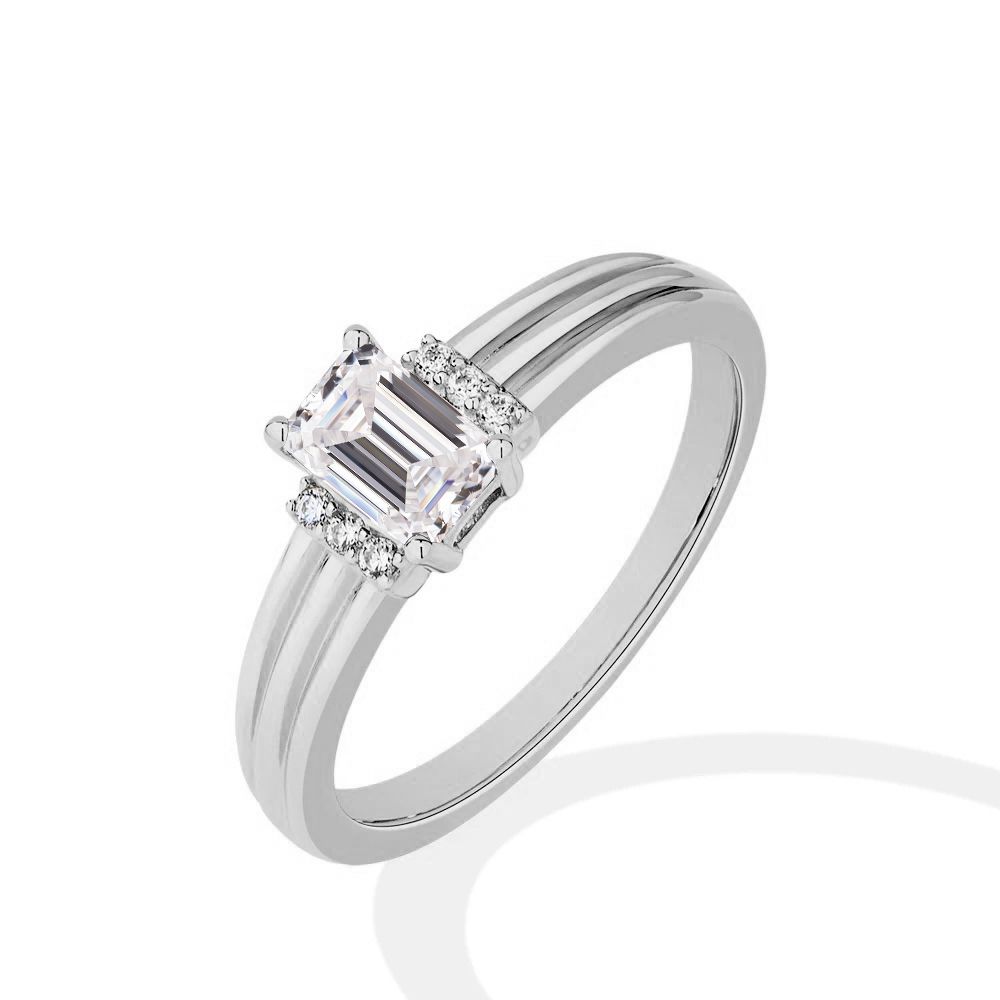
A prong does not snap because it is old. It snaps because a jeweler, or the owner, let it get thin. The warning period is usually months long, and it is visible to anyone who knows what to look for.
What is actually happening
A prong is a small finger of metal bent over the edge of a stone. On a four-prong setting the whole stone is held by four pieces of 14k or 18k gold that are often 0.8mm to 1.2mm thick at the tip. Every day that ring rubs against a pocket, a keyboard, a seatbelt, a door handle. Gold is soft. It moves, and it wears.
Three things go wrong, in this order.
- The tip thins. Rubbing polishes metal away until the prong is a flat pad instead of a rounded claw.
- The prong lifts. Once thin, it bends rather than springs back, and a gap opens between tip and stone.
- Something catches. A thread, a scarf, a towel loop. The pull either bends the prong further or snaps it at the base.
Platinum behaves differently from gold. It does not wear away so much as displace, so a platinum prong gets a mushroomed lip rather than going thin. It still needs tightening. Rhodium-plated white gold adds a fourth problem, because plating hides the surface underneath until it flakes.
How to inspect your own ring at home
You need a bright light, a dark background and about ninety seconds. A phone camera zoomed in works well.
- Look at the tips. A healthy prong has a rounded, shiny dome. A tired one looks flat, dull or slightly cupped, like a worn pencil eraser.
- Look for a shadow. If you can see a dark line between the prong tip and the stone, there is a gap. That is the single most useful check.
- Wiggle gently with a fingernail. The stone should not move at all. Even a faint tick means stop wearing it.
- Run a fingernail around the setting. If anything catches, note where.
- Check the girdle. A thin girdle with a worn prong is the combination that chips stones.
Do this every three months or so. It takes less time than making coffee.
What we do at the bench
Tightening a loose prong takes an hour. We seat the stone back against its bearings, work the prong down with a beading tool, then burnish the tip smooth with a polished graver. That is the whole job, and it costs $35 to $60 per prong on a standard setting.
If the prong has already worn past roughly half its original thickness, retipping is the honest call. We build up new metal at the tip with a laser welder and reshape it. That runs $70 to $120 per prong because it is slower work under magnification. On a six-prong setting where four prongs are thin, replacing the whole head is usually cheaper than four retips, and stronger.
What we will not do is bend a thin prong back into place and send the ring home. It holds for a few months, then it fails, and the failure is usually on a weekend or a holiday.
The failure case
The worst job that came across our bench this year was a three-stone ring where the center stone had been loose for a while and nobody noticed. It rotated inside the setting and scratched the two side stones against their neighbours. The prongs cost $90 to fix. The two side stones cost $340 to replace. We photograph every setting under a loupe before and after service now, mostly so clients can see what changed.
A stone that falls out at a checkout counter or in a swimming pool is almost never found. The inspection is cheap. Keep the receipts, and if your ring was made by us, the first tightening is on the house within two years.