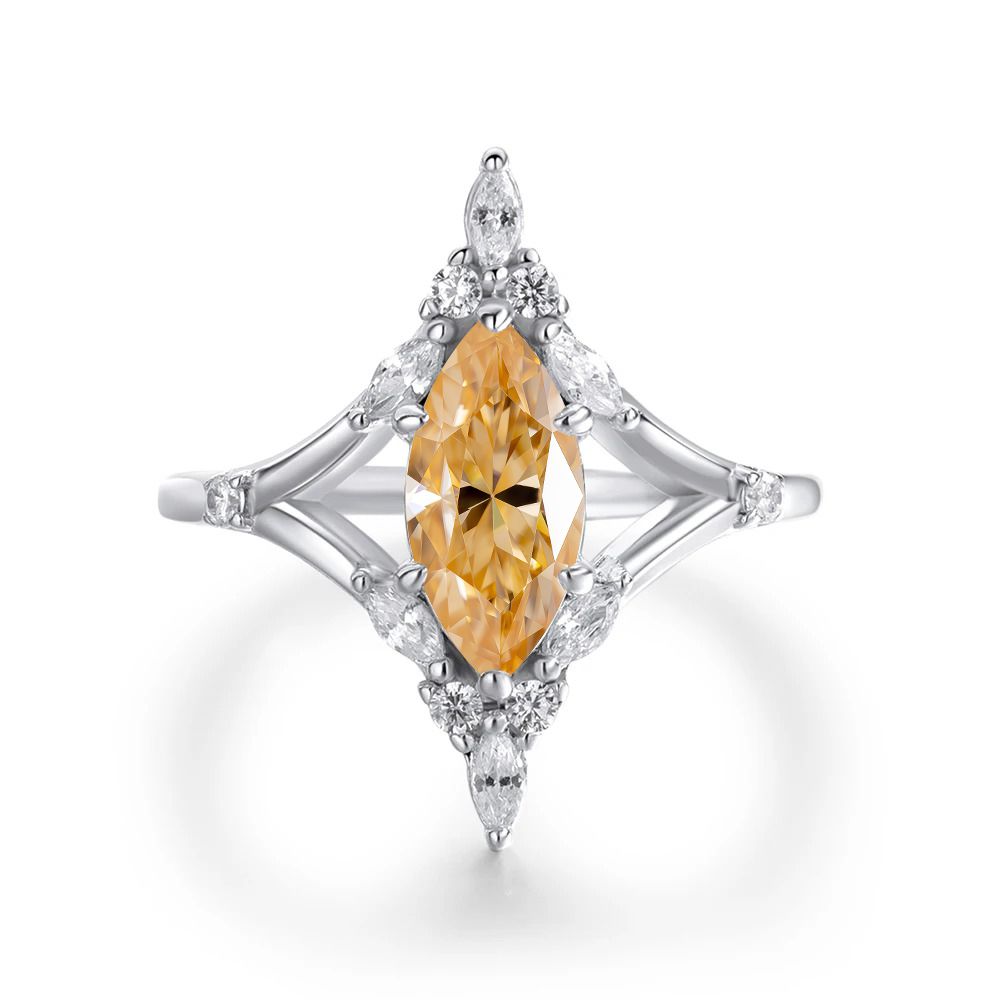
We set moissanite almost every day, and we have set natural diamonds too. Clients ask us, constantly, which one they should choose. We will give you the answer we actually give across the bench, not the marketing version.
What they are. Diamonds are carbon crystals mined from the earth. Moissanite is lab-grown silicon carbide, first discovered in a meteorite. Visually, a well-cut moissanite rivals a diamond in brightness and actually out-sparkles it in fire (the rainbow flashes), because it refracts light more.
Price. This is where the decision usually gets made. A 1ct-equivalent center in a fine moissanite is a fraction of the cost of a comparable diamond. That means, for the same budget, you can build a ring with a much larger stone, a finer setting, and a metal you actually love instead of settling. For most couples walking into our studio, that is the whole argument.
Durability. Both are extremely hard and suitable for daily wear. Moissanite scores slightly below diamond on hardness but well above everything else a normal life would throw at a ring. It will not scratch or chip in ordinary use.
Honest caveats. Moissanite does have a slightly different refractive signature — under a jeweler's loupe, an expert can tell. In very rare, specific lighting, some people perceive a faint gray-green tone in larger stones. High-quality colorless moissanite is corrected for this, which is why we only use graded, GRA-certified stones.
Our recommendation. If budget, size and sparkle matter most to you — and for most people they do — a graded moissanite lets us build a ring you could never afford in diamond at the same scale. If resale value or traditional diamond provenance is the deciding factor, that is a different conversation, and we will tell you that plainly too.